 |
The Big Bug Band

Years 2 - 6 |
Summary
James Burnett & Calvin J. Irons, Origo Education, 2010
Illustrated by David Pearson
ISBN 1 9213 5852 1
This is a big book to be shared as a class or group reading adventure. The bugs organise themselves into a band and march in formation through the town. Just like all other marching teams, they are arranged in arrays as they parade. A wonderful opportunity to act out and make models based on the lively images in the book.
Acknowledgement
This book was 'discovered' by Year 1/2 teachers from Sacred Heart School, Pearce.
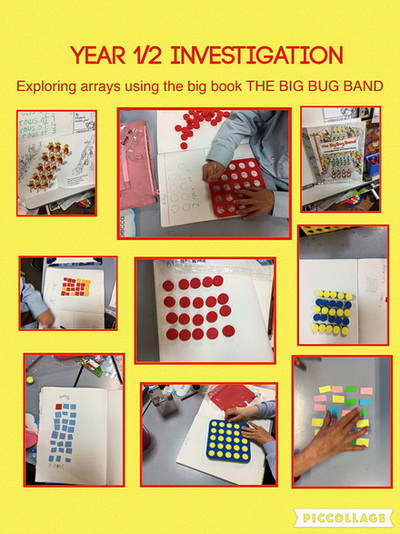
Maths leader, Lisa Binutti-Wilson created the collage for display on the staffroom maths wall.
Materials
- One Poly Plug per pair
- One calculator per pair
|
|
Procedure
- Enjoy the book with the class. You could read it cover to cover, or you could make it more of an adventure by sticky-tacking blank paper over some or all of the text (not the cover). Depending on the class this could lead to challenges such as these, each of which will lead to its own discussion and recording:
- I have hidden all the words in this book. I want to find out what we can learn from it anyway. Can we figure out the story? Record comments and predictions as you 'read' the book.
- How could we check our hypotheses? ... Okay I will remove the paper on one of the pages. Which page do you want to see in full?
- Continue the process of reveal, discuss, record as appropriate then challenge with ... This time I will reveal the text on this page; but not until your group has written the text you think would work for the page. It's not about guessing what's underneath. It's about making up some words that might work with this page AND what we already know about the whole book.
- Explore physically making marching groups with different numbers of children. Make sure you have the 'barriers' marked on the 'road' as in the illustrations in the book. (It might be best to go outside or into the multipurpose room.) The barriers make it easier to see, for example, that four bugs could march down the road in three different arrays.
|
|
Content
- counting
- division
- mathematical conversation
- mathematics & literacy partnership
- multiples, factors & primes
- multiplication - array model
- multiplication
- recording - calculator
- recording - written
- square numbers/square roots
- subitising
- times tables
- visual and kinaesthetic representation of number
|
- Return to the book and look at the illustrations. Look at the crowds beside the parade and look at the bugs in the band. Tell me what's different.
- Discuss the fact that the band marches in rows and check back through the illustrations to count the number of rows, the number in each row and the total. (Rows go across your tummy.)
- Record some of this counting on the calculator using both repeated addition and the X, which can be referred to as 'rows of'. Four example the total of 3 rows of 4 band bugs can be found on the calculator using 4 + 4 + 4 or 3 X (rows of) 4.
- Spend lots of time making bug bands of various sizes with Poly Plug and recording with calculators and in maths journals. These investigation could include questions like:
- Which size bug bands could march down the street in only two different ways?
- Which size bug bands can march down the street in only three different ways?
- Which size bug bands can march down the street in more than three different ways?
- Which size of bug band (up to 25 in total) can march down the street in the most different ways?
- Which size bug band can march down the street in only one different way? (Note: This is why 1 is not included as a prime number.)
- ...and much more.
- If appropriate for the year level, introduce or reinforce terms like square number, rectangle number, prime number, factor, multiple and product.
- Ask backwards questions like:
- There are 18 bugs in the group and the leader wants them in 2 rows. How many will be in each row?
- There are 15 bugs in the group and the leader wants 5 in each row. How many rows will there be?
- Use calculator games 6 Times (variation on 6 Plus) and Calculator Squares (Part 2 of the notes) to practise times tables skills in a problem solving context.
- Many other ideas are supplied by Origo in their teaching notes for this book.
- Consider rounding off the sequence of lessons by dressing up in coloured costumes, with hats, and marching around with lots of percussion instruments. There are opportunities within this for the children to create percussion music patterns to follow (for example, to a count of 4, drum, drum, drum cymbal, drum, drum, drum, cymbal... - what happens if the same pattern is put to a count of 3?). The hats could be made from card cut and folded into geometric objects such as cylinders (like the hat of the Cat in the Hat), cones (like the hat of any reasonable witch or wizard), or cubes (very fashionable pill box style).
We look forward to adding comments and photos from your class to this activity.
Return to Calculating Changes
Activities
Calculating Changes ... is a division of ... Mathematics Centre
|